

The little 90s nerd
I learned how to type before I properly learned how to write with a pen.
That probably explains why my handwriting still looks like shit.
I’m an early-’90s kid. I was born in 1992, which means I grew up in a very strange and very interesting technological window.
I didn’t grow up after the digital revolution.
I grew up inside it.
Computers were already around when I was a child, but they were still machines you had to learn. The internet made noises before it connected. Websites were crude. Storage was expensive. Phones were phones. Software came in boxes. You could watch technology changing almost year by year.
And I loved every fucking minute of it.
I was fascinated by computers from the time I was little—not just games, but the machines themselves. I wanted to know what was inside them, why they behaved the way they did, how software worked, how networks worked, and how a website could appear on a screen thousands of kilometers away.
That fascination eventually became useful.
I started working with web development in my teens, studied software engineering, and eventually made technology part of my professional life.
Over the years, I watched dial-up disappear, broadband become normal, websites turn into applications, phones become pocket computers, storage become ridiculously cheap, cloud computing change infrastructure, and algorithms quietly take over tasks that once needed much more human intervention.
The progress wasn’t always dramatic when you were standing inside it.
It came piece by piece.
But when you look backward, the distance is insane.
And through all of that, I always had the same feeling:
This is going somewhere much more interesting.
Maybe that’s what happens when you grow up as a nerd watching Star Trek and other science fiction.
You see people casually talking to computers, machines translating languages instantly, medical systems analyzing patients, autonomous systems navigating space, and computers answering questions as naturally as another person.
And you don’t just think:
Cool story.
You think:
We’ll build that shit eventually.
We are the dreamers of dreams.
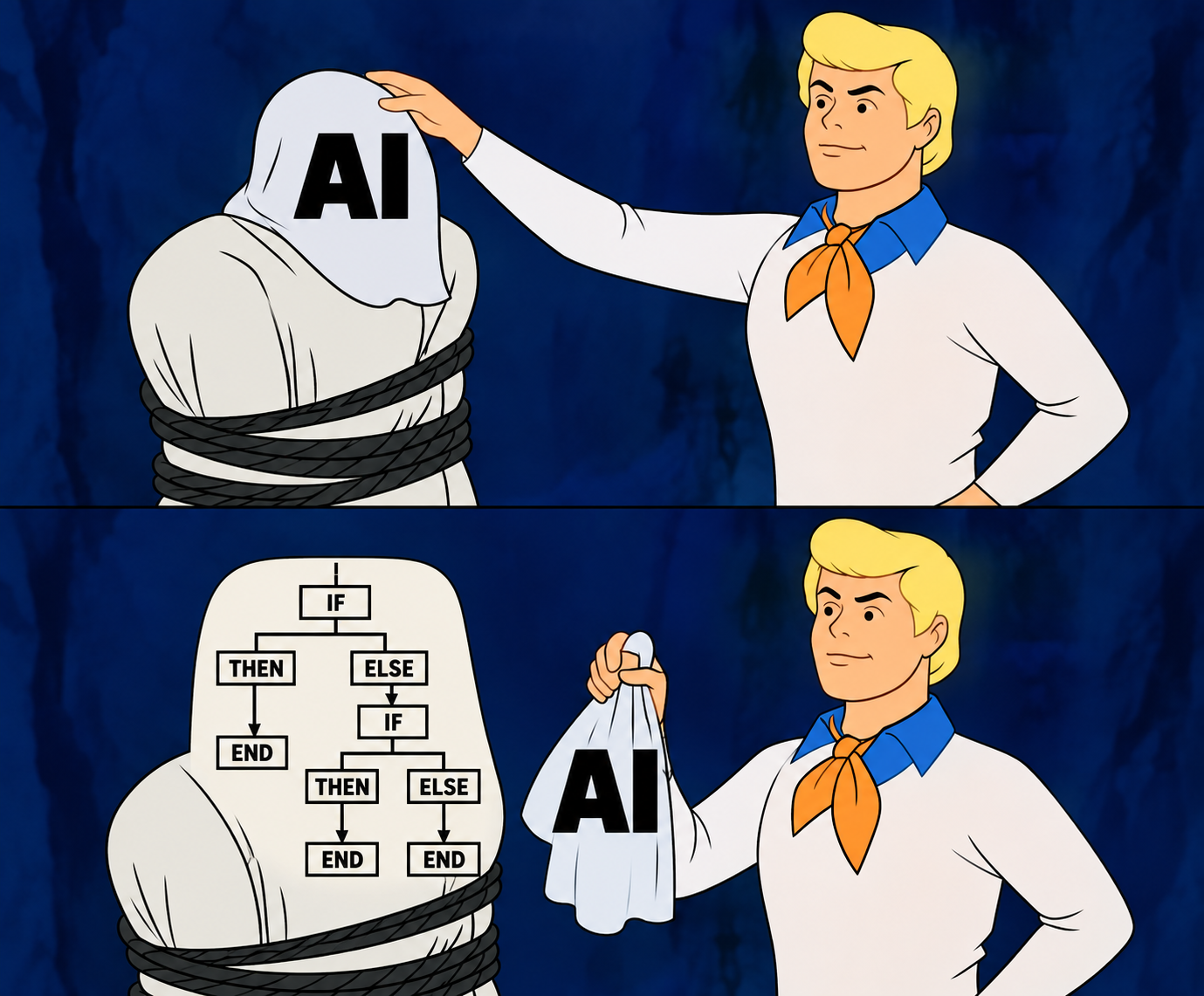
And artificial intelligence did not suddenly appear when the general public discovered ChatGPT.
Not even close.
AI Was Already Here
Artificial intelligence has a history stretching back decades.
Long before people were arguing about ChatGPT on Reddit, AI researchers were building expert systems, neural networks, computer-vision systems, speech recognition, game-playing machines, autonomous systems and other forms of machine intelligence.
The field went through breakthroughs, disappointments, hype cycles and even entire “AI winters” when expectations outran what the technology could actually deliver.
Meanwhile, machine learning and related systems slowly disappeared into ordinary technology.
Spam filtering.
Fraud detection.
Recommendation systems.
Speech recognition.
Search ranking.
Translation.
Computer vision.
Navigation.
Industrial automation.
Medical analysis.
Scientific research.
Astronomy and astrophysics.
For many people, AI was already affecting their lives before they had any reason to think about the term artificial intelligence at all.
And I don’t blame people for that.
Most people aren’t software engineers.
Most people aren’t computer scientists.
Most people aren’t obsessive nerds who want to know what algorithm decided which photograph appears first on their phone.
AI was mostly invisible.
Then something changed.
The public got a text box.
Then Everyone “Discovered” AI
Large language models changed the relationship between ordinary people and artificial intelligence because suddenly the interface was something everyone already understood:
Language.
You didn’t need to understand programming.
You didn’t need to know what a neural network was.
You didn’t need APIs, command lines or some research background.
You could just talk to the machine.
And it talked back.
That was the revolution for the general public.
Not the invention of AI.
Access to AI.
Within a remarkably short period of time, millions of people who had never thought seriously about artificial intelligence were using it every day.
And because LLMs became the public face of the technology, a strange simplification happened:
AI became synonymous with chatbot.
ChatGPT is AI.
Claude is AI.
Gemini is AI.
The little box where you type your question is AI.
But LLMs are not everything AI is about.
Not remotely.
They’re incredibly important. Natural language may turn out to be one of the most important interfaces humans have ever created for computers.
But the future of artificial intelligence is much bigger than generating paragraphs.
The more interesting question is:
What happens when useful machine intelligence becomes cheap enough to put fucking everywhere?
My Problem Isn’t AI
I have concerns about AI.
Plenty of them.
But AI itself isn’t what irritates me the most.
People do.
Or more specifically, the way some people use it.
Give humanity a machine capable of helping us learn, program, research, analyze, translate, organize information and explore ideas faster than before, and naturally somebody will use it to avoid reading three paragraphs.
Students copy assignments into an LLM, submit whatever comes back and learn absolutely nothing.
People ask AI what they should think about a subject they haven’t bothered trying to understand.
Someone receives an answer, verifies nothing, and immediately repeats it online as fact.
That isn’t using AI to reduce unnecessary work.
That is outsourcing the thinking.
And that distinction matters enormously to me.
AI should help you do the work.
It should not do your thinking for you.
If anything, access to a system this powerful means you should become more critical, not less.
Ask better questions.
Check sources.
Challenge answers.
Understand the field you are working in.
Know enough to recognize when the machine is confidently talking shit.
Because the machine can produce something convincing long before it produces something correct.
And unfortunately—or fortunately, depending on how annoyed I am that day—it’s a fucking democracy.
I don’t get to decide how everyone else uses technology.
People are free to use one of the most powerful intellectual tools we have ever created to avoid thinking.
I’m equally free to think that’s stupid.
AI Is as Smart as the Person Who Uses It
Since LLMs became widely available, I’ve repeated the same sentence:
"AI is as smart as the person who uses it."
That obviously isn’t a literal law of computer science.
A capable model has abilities regardless of who opens the application.
What I mean is that the value you get from AI depends enormously on what you bring to it.
Knowledge matters.
Experience matters.
Judgment matters.
Curiosity matters.
Knowing when something smells wrong matters.
Two people can have access to exactly the same model and get radically different results.
One person can use it as a replacement for understanding.
Another can use it as leverage for the understanding they already have.
That difference has become incredibly obvious to me in software development.
AI Slop, Real Engineering and the End of Typing Everything Yourself
AI has changed my professional web-development work dramatically.
Commercial projects that once might have taken me three or four weeks can sometimes now be completed in one to three days.
That is not a small productivity improvement.
That is a different workflow.
But I’m not talking about typing:
“Build me a website.”
…and deploying whatever falls out.
I’m talking about professional commercial development, where AI speeds up implementation but doesn’t remove the engineering. The requirements still have to be sound, the architecture deliberate, the security and performance considered, the code reviewed and tested, and the deployment handled properly.
And somebody still needs to understand what the fucking system is doing when something breaks.
AI has not replaced my software-engineering knowledge.
It has multiplied what I can do with it.
That’s why I find some of the online conversation around “AI slop” so irritating.
There absolutely is AI slop.
A lot of it.
People generate software they don’t understand and publish it without proper testing, planning or engineering.
Fine.
Call that shit what it is.
But AI-assisted work is not automatically AI slop.
An independent developer can build something quickly with AI assistance and still understand every important architectural decision behind it.
Yet someone who doesn’t know shit about software development will sometimes see one person shipping quickly and immediately decide:
“AI slop.”
Based on what?
And the hypocrisy gets even funnier when the same people use AI themselves and then go online to perform outrage about everybody else using it.
Use it privately.
Condemn it publicly.
Apparently that’s a business model now.
The interesting part is that experienced developers are increasingly describing exactly the same transformation I’ve been seeing.
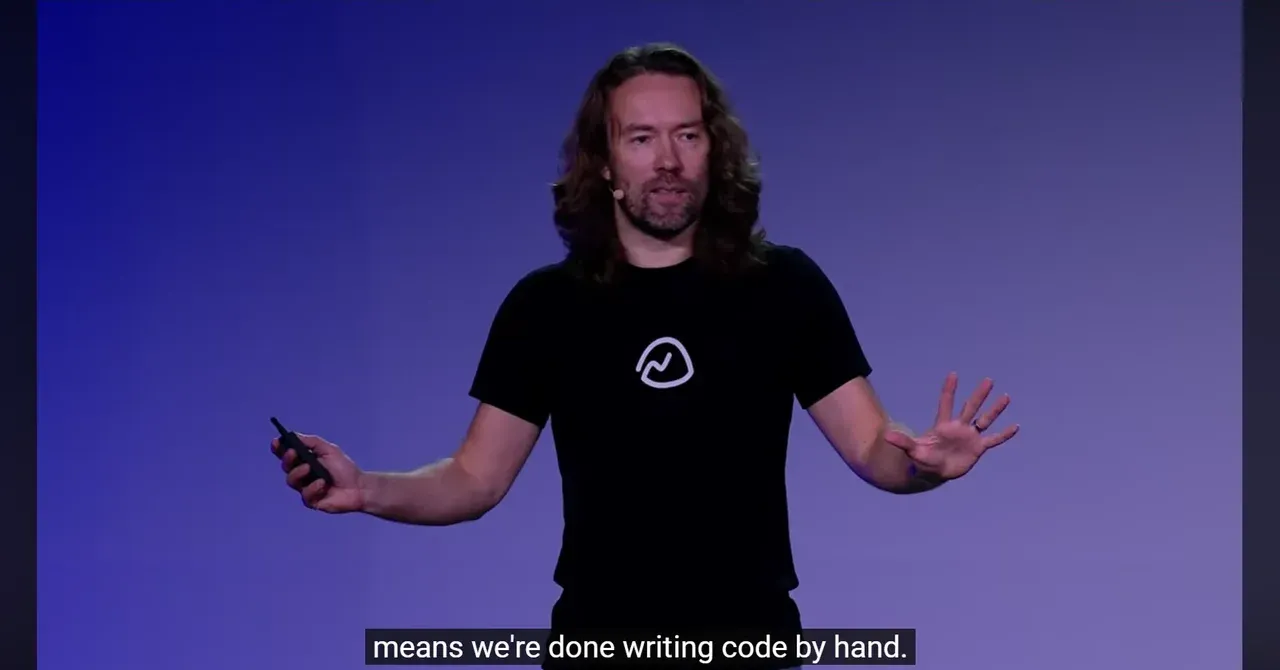
At Rails World 2026, Ruby on Rails creator David Heinemeier Hansson—DHH—talked about 37signals effectively going “pencils down” on handwritten production code.
This is particularly fascinating because Ruby on Rails was built around the idea of programmer happiness.
DHH spent decades caring deeply about what programming felt like for humans.
And now he’s saying that a huge amount of implementation can be handed to agents.
He described historically producing around 30,000 lines of production Ruby in a year and then generating roughly 150,000 lines of code in a single month using agents—while correctly noting that the newer Rust code was much more verbose, so raw line counts aren’t a clean productivity measurement.
The exact multiplier isn’t the important part.
The direction is.
The mechanical act of typing source code is becoming cheaper.
And that exposes something that good engineers already knew:
Typing code was never the hardest part of software engineering.
Understanding the problem was.
Designing the system was.
Knowing the tradeoffs was.
Security was.
Debugging was.
Understanding what the customer actually needed was.
Recognizing when a technically correct implementation was still a terrible idea was.
If AI can take over more of the mechanical implementation, the engineer doesn’t necessarily disappear.
The engineer moves upward.
DHH ended his keynote with a deliberately aggressive line:
“The black pill is for fucking losers. Don’t be a loser.”
I understand exactly what he means.
You have an army of coding agents available to you and you’re spending your time mourning the economic value of manually typing every curly bracket?
For fuck’s sake.
Build something.
And What About Art?
There’s another fight happening around AI that I’m deliberately not going to solve here:
Is AI-generated art actually art?
Music.
Painting.
Drawing.
Animation.
Film.
Photography.
Writing.
That argument gets philosophical very quickly.
And honestly, it deserves its own article.
But technology has challenged our definition of art before.
A painter might spend days or weeks manually reproducing a scene.
A photographer can press a button and capture an image in a fraction of a second.
Does that mean the photographer isn’t an artist?
Obviously not.
The camera performs much of the mechanical image-making, but composition, timing, perspective, intention and selection still matter.
AI makes that question far more complicated because the machine participates much more deeply in the creation itself.
Where does human direction end?
Where does authorship begin?
How much of art is manual craft, and how much is intention?
I don’t have a neat answer.
And I’m not opening that philosophical can of worms here.
We have enough problems already.
And Then AI Started Doing Mathematics
Software development is one thing.
Scientific discovery is where my optimism becomes much more serious.
In September 2026, OpenAI announced an AI-generated mathematical result addressing the Navier–Stokes existence and smoothness problem, one of the famous Millennium Prize Problems.
The Navier–Stokes equations describe fluid motion and are fundamental to areas ranging from airflow and weather to blood flow and astrophysics.
The mathematical question surrounding the possible development of singularities in three-dimensional flows had resisted mathematicians for decades.
According to OpenAI, thousands of coordinated agents explored the problem over roughly 88 hours, followed by additional formalization and verification in Lean.
Think about what that represents.
Not:
“Summarize this paper.”
Not:
“Write me an email.”
Not:
“Make a picture of a cat wearing sunglasses.”
A machine system exploring an enormous mathematical search space using large numbers of cooperating agents.
Now, this is exactly where AI optimism needs to keep its fucking head attached.
A machine producing a proof does not mean humans simply shrug and go home.
Important mathematics still has to be examined.
Verified.
Understood.
Criticized.
Connected to existing knowledge.
And that creates an even more interesting scientific question:
What happens when machines can discover answers faster than humans can completely understand the path to them?
That isn’t the end of science.
That is a new frontier of science.
Humans still have to ask:
Why does this work?
What does it mean?
What can we generalize from it?
What other questions does it open?
How does it connect to the physical world?
How can we turn machine discovery into human understanding?
So when I see AI participating in mathematics, I don’t think:
Well, mathematicians are fucked.
I think:
Holy shit. Look at the instrument mathematicians just got.
AI Doesn’t Even Need to Talk
This is also why reducing AI to LLMs is such a mistake.
TypeSafe AI recently introduced Jev, which it describes as a System One model.
Jev isn’t designed to write essays or have philosophical conversations.
It makes constrained, structured decisions.
Instead of producing arbitrary text, it can evaluate predefined options and return probabilities or scores that other software can use directly.
That sounds less exciting than a chatbot until you think about where it could go.
Fraud detection.
Routing decisions.
Document classification.
Sensor analysis.
Risk evaluation.
Background software decisions.
Autonomous systems.
Thousands or millions of tiny judgments happening continuously.
Most of those tasks do not need a giant artificial brain writing beautiful prose.
They need something fast, cheap and reliable enough to make useful decisions.
So maybe the future isn’t one enormous AI doing everything.
Maybe it’s an ecosystem.
Small models making rapid decisions.
Large models doing complicated reasoning.
Coding agents building systems.
Scientific systems exploring hypotheses.
Vision models interpreting environments.
Robots interacting with the physical world.
And humans deciding what the hell all of those systems should be trying to accomplish.
Intelligence Is Getting Cheaper
This is where the bigger story starts.
Computers made calculation cheap.
The internet made information distribution cheap.
AI may make certain forms of intelligence cheap.
And when something useful becomes dramatically cheaper, we don’t usually just do the same things for less money.
We invent things that previously made no economic sense.
That is one reason the next stage of AI development could be much more interesting than chatbots.
A researcher might explore twenty hypotheses instead of two.
An engineer might test ten possible designs before committing to one.
A small company might have access to analytical capabilities once limited to huge corporations.
A programmer might prototype several completely different architectures in a day.
A scientist might send thousands of agents down thousands of possible mathematical paths overnight.
The bottleneck starts moving.
Execution becomes cheaper.
The question becomes more valuable.
Progress Builds on Progress
I’m careful with the word exponential, because technology doesn’t follow one magical exponential curve forever.
But technological progress absolutely compounds.
One breakthrough becomes infrastructure for another.
Better processors allow larger and faster AI systems.
Better AI systems accelerate software development.
Faster software development produces better scientific tools.
Better scientific tools accelerate research in medicine, materials science, energy, robotics and engineering.
Those discoveries improve the hardware and systems we use to build the next generation of technology.
Then the cycle repeats.
That feedback loop is where things become fascinating.
And we’re already seeing fields begin to reinforce one another.
AI and robotics.
AI and medicine.
AI and materials science.
AI and biology.
AI and engineering.
AI and astronomy.
AI and space exploration.
Not because AI is some magical replacement for every scientist in the world.
Because it can reduce the amount of intellectual labor required to explore a possibility.
Stop Thinking So Small
A lot of public discussion about AI is weirdly small.
Will AI write my email?
Will AI steal my job?
Will students cheat?
Will programmers still type code?
Those are real questions.
But they’re not the only questions.
What if AI helps us discover new medicines faster?
What if it helps us understand diseases we currently barely understand?
What if it accelerates materials research enough to unlock better batteries, better energy systems or entirely new manufacturing techniques?
What if every student eventually gets access to a genuinely useful personal tutor?
What if robots become capable of performing dangerous work humans should never have needed to do in the first place?
What if scientific experimentation becomes partly autonomous?
What if we can explore possibilities at a scale human research teams simply cannot?
And eventually:
What happens when we start seriously leaving Earth?
Space exploration is one of the clearest examples of why increasingly autonomous intelligence matters.
The farther you travel from Earth, the less practical direct human control becomes.
Communication delays grow.
Environments become hostile.
Machines need to diagnose problems, make decisions and adapt without waiting for someone sitting comfortably on Earth to tell them what to do.
If humanity eventually becomes a genuinely spacefaring civilization, autonomous intelligence is almost certainly going to be part of that story.
AI isn't going to magically hand us a warp drive next Tuesday.
But science compounds.
Engineering compounds.
Knowledge compounds.
And tools that help us explore possibilities faster can accelerate everything built on top of them.
That is why I find it difficult to look at this technology and feel only fear.
Technology Will Not Save Us
None of this means technology automatically creates a better civilization.
Humans still have to decide what to do with it.
Nuclear physics gave us nuclear power and nuclear weapons.
The internet gave us access to an enormous fraction of humanity’s accumulated knowledge and somehow also gave us fucking TikTok.
Smartphones put computers more powerful than the machines that sent humans to the Moon into billions of pockets.
And naturally we used them to argue with strangers while sitting on the toilet.
That’s humanity.
Technology expands the space of what is possible.
It does not guarantee that we choose wisely.
AI will be no different.
It can be used for science.
It can be used for scams.
It can help somebody learn.
It can help somebody avoid learning.
It can amplify intelligence.
It can amplify stupidity.
That is exactly why I refuse both extremes.
I don’t believe AI will automatically save humanity.
And I don’t believe AI automatically destroys humanity either.
It is a technology.
A very powerful one.
And what we do with powerful tools still matters.
The Choice Isn’t AI or No AI
Some people still talk about artificial intelligence as though society is holding a referendum.
Should we allow AI?
Guys.
That meeting already happened.
You missed it.
The models exist.
The infrastructure exists.
Companies are using them.
Scientists are using them.
Programmers are using them.
Governments are using them.
Students are definitely fucking using them.
The question isn't whether AI is coming.
The question is what you are going to do in a world where it is already here.
You can reject everything.
Refuse to learn how any of it works.
Complain every time technology changes around you.
You can also go in the opposite direction and surrender your entire brain to it.
Let it decide what you think.
What you write.
What you believe.
What you understand.
I think both approaches are stupid.
There is a third option.
Learn.
Understand the technology.
Understand its limitations.
Understand your own field.
Use AI aggressively where it makes you stronger.
Question it where it can be wrong.
Verify important claims.
Keep developing your own expertise.
Keep your fucking brain switched on.
Because yes, jobs will change.
Some jobs will disappear.
Entire professions will probably look very different twenty years from now.
There will be economic disruption.
Scams.
Misinformation.
Corporate bullshit.
Policy fights.
Mistakes.
I'm not pretending otherwise.
Maybe Uncle Sam and Uncle Elon will eventually throw you a bone to chew on once the disruption hits. I’d rather adapt before I’m hungry enough to need it.
I’d rather not build my life plan around that possibility.
I’d rather learn how the fucking system works.
I'm an AI Optimist
Being optimistic about artificial intelligence does not mean believing every AI company.
It doesn't mean every benchmark is trustworthy.
It doesn't mean every model is brilliant.
It doesn't mean AGI arrives next Tuesday.
It doesn't mean jobs don't matter. (Actually, a lot of them don't)
It doesn't mean environmental costs don't matter.
And it definitely doesn't mean humans become unnecessary. (Meeeeh, JK!)
It means I look at what these systems are already capable of and see possibility.
I see programmers capable of building things that once required teams.
I see scientists gaining tools capable of exploring intellectual spaces humans could barely navigate alone.
I see specialized intelligence becoming faster and cheaper.
I see the cost of experimentation falling.
I see technologies beginning to reinforce one another.
And I see possibilities much larger than another chatbot.
Better science.
Better medicine.
Better engineering.
Better education.
New fields we haven't named yet.
And eventually, perhaps, a civilization capable of doing things that today still belong to science fiction.
I grew up watching technology transform the world one step at a time.
I watched the internet arrive.
I watched computers become ordinary.
I watched phones become computers.
I watched software swallow entire industries.
And now I’m watching machines begin to participate in intellectual work.
For the little nerd staring at a computer screen in the 1990s, this is the kind of future I hoped I might live long enough to see.
So no, I’m not going to spend it looking down.
I’m going to learn more, build more, research more, ask harder questions, try stupid ideas, and explore things that would have been completely out of reach for one person not that long ago.
And I’m going to use every fucking tool available to me along the way.
Because AI should not replace human intelligence.
It should amplify it.
It should extend our reach, lower the cost of curiosity, and let us attempt things that used to require more time, more money, more people, or simply more luck.
But none of that means much if the human on the other side stops thinking.
So keep your brain switched on.
Learn what the machine can do.
Learn what you can do with it.
And then go build something worth building.
Use the damn thing.
And remember, "AI is as smart as the person who uses it."